Brentano Quartet Plays Beethoven and Bartók
May 03 2026I always enjoy seeing Beethoven quartets performed, and I was especially excited for this one because this program included Op. 18 No. 2, which I had performed a few years earlier. This recital introduced me to the Brentano Quartet, and they also did Beethoven’s Op. 18 No. 1 and Bartók’s fourth string quartet. We had great tickets, right up front and in the middle, at the Bing Concert Hall at Stanford University.
The Brentano Quartet have a very interesting and delicate style. The openings of both Beethoven Quartets have some unison pauses, and the Brentano really soak in and bask in the pauses. I would actually say that they take too much time in the pauses, but it’s a really nice balance where they take like 20% too much time on the rest, but then they come in completely in tempo. I don’t even see anyone obviously leading the timing of the rest; every member seems to just know exactly how long it should be. The effect is very interesting, and it could only be done by a quartet that has played together with each other for a long time and completely trust each other.
Overall, I thought the Beethoven quartets were really great. The performances are not what I would consider as “reference” performances. That is, if someone is hearing the quartets for the first time, I wouldn’t recommend the Brentano Quartet. I think these performances are for people that are very familiar with the Beethoven (which is probably much of the audience), and they do a great job of coloring outside the lines. The performances are definitely not very romantic. There are no great climaxes, no passionate vibrato, etc. which are easy to fall into as a Beethoven performer. Instead, it is extremely refined, subtle, and playful.
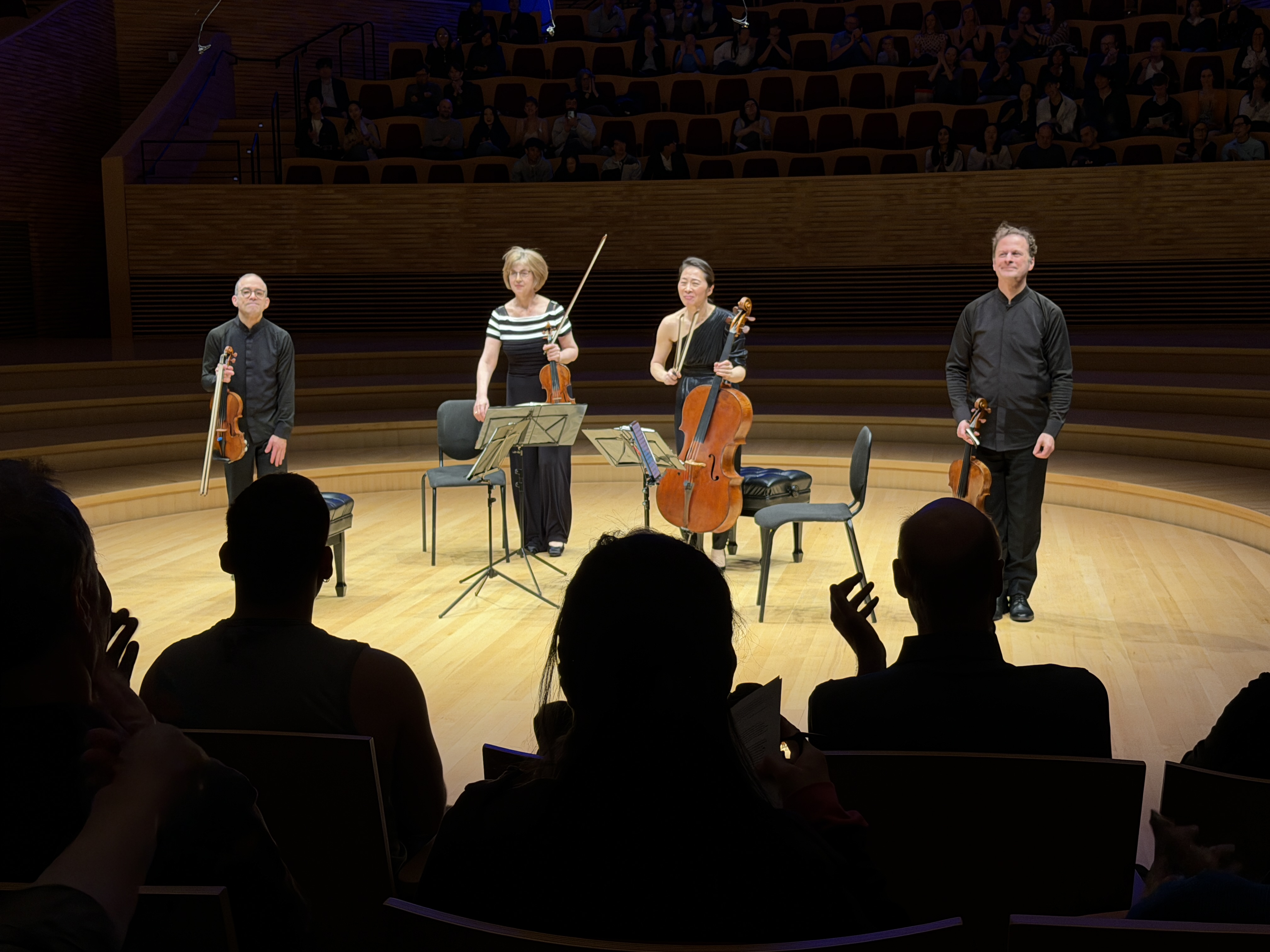
I am not familiar with the Bartók, but I am familiar with the Bartók snap pizzicato. The fourth quartet has two entire movements that feature this snap pizzicato. I noticed that 2 of the musicians brought an extra bow on stage, and I wasn’t sure why. After some quick Googling, it’s apparently because the rosin dust and aggressive strikes from the Bartók pizz can easily damage or ruin the expensive primary bow, which is why players keep a dedicated “snap bow” on hand to spare their main bow the wear and tear. I’m still not sure it makes a ton of sense. Overall, I liked the symmetric format of the Bartók, but it obviously lacks in gorgeous melodies.
comments powered by Disqus